

Martech
Growth Operations
Expand
Optimize performance and reduce technical debt. Ideal for efficiency and fine-tuning.


Product-market fit (PMF) is a term that refers to the degree to which a product satisfies the needs of a particular market. It's an important concept in the world of business, as it can help companies understand whether or not their product is likely to be successful in the market.
If you'd love to understand more on how to do so with a step-by-step approach, download our Growth Guide here
To give you better clarity we've provided some amazing guides from the team at Reforge and Initialized VC to help you get close to your goals
If you're new to the idea of Growth, we'd strongly recommend that you take some time to read Reforge's contents to indulge in the best strategy that will help you understand the concept of Growth as a whole!
Below is a glimpse on the how the top executives at reforge have given us a bird's eye view on the target we need to set our eyes on if you'd like to achieve the big Billion!

According to the team at Initialized, these are some of the targets you'd need to set your eyes on from the get-go.
( They've invested in companies like reddit, Instacart, Coinbase, Algolia and more! )

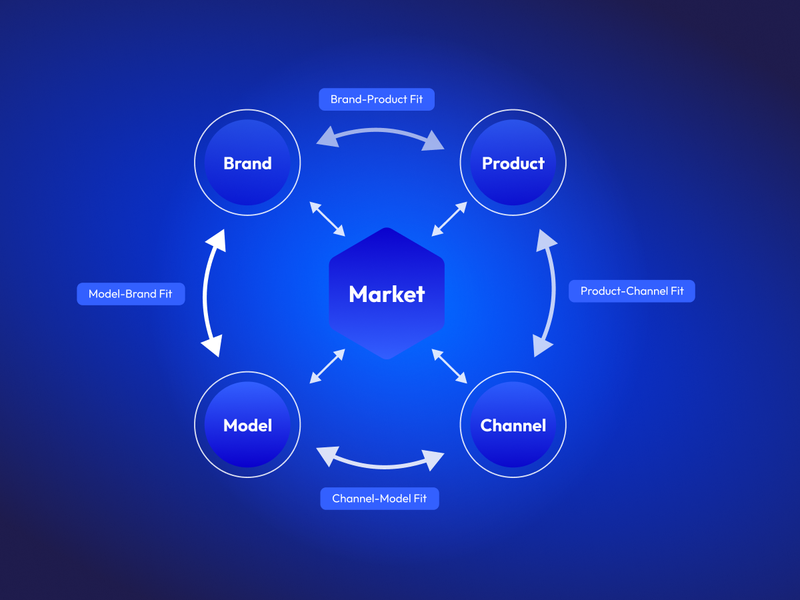
Look through Brian Balfour's Series on the 4-fit model to go down the rabit hole, we're sure you'll understand how to validate your Product Market Fit by then.
Overall, achieving product-market fit is a process that requires ongoing effort and iteration. By following the steps outlined above, and using the right tools and techniques, modern day marketing teams can position their products for success in the market.
Here are also a couple more recommendations we'd suggest for you to add on top of Webflow to ensure that your growth team is fully stacked with the best in breed tech stack:
[Image: https://cdn.prod.website-files.com/6865f214611c12321382e726/6865f214611c12321382...]
[Image: https://cdn.prod.website-files.com/6865f214611c12321382e726/6865f214611c12321382...]
[Image: https://cdn.prod.website-files.com/6865f214611c12321382e726/6865f214611c12321382...]
Asia is home to over half the world’s population and some of the fastest growing economies. It’s an exciting opportunity for digital solutions. However, it’s also a complex region with fragmented cultural norms, languages, and infrastructure. This poses unique challenges when it comes to achieving product market fit. Here, we break down a strategic approach to measure and validate fit in Asian markets as you scale.
Product market fit is traditionally defined as the moment when a startup’s product resonates with a sizable target customer base. But how do you pinpoint that moment in a region as vast and fragmented as Asia? The key is adopting a localised perspective.
Asia lacks a unified market. Consumer needs and behaviours not only vary hugely between regions, but even within countries themselves. What flies in Singapore may flounder in Manila. Equally, digital maturity differs. Internet speeds, mobile adoption rates, even UI expectations differ across Asia.
Therefore, we need to reframe "product market fit" for Asia as "market product fit." This means deeply understanding local user problems first, then building culturally tailored solutions. Achieving fit requires localisation at every step.
Product-market fit is the holy grail for any startup. But fit looks different across business models, and fragmented Asian markets pose unique challenges. This guide details a strategic approach to measure and validate fit tailored to 9 startup models in Asia.
We can't take a blanket North American approach to fit in Asia. Adopt a localised perspective:
Craft tailored solutions for unique Asian user problems.
Metric Targets:
Tactics:
Example: HubSpot initially offered a freemium model optimised for viral and paid acquisition. Once product-channel fit was proven, inbound sales provided leverage to expand through partners. Localisation has focused on packaging and translations.
Metric Targets:
Tactics:
Example:Vertexadapted its tax automation platform for local languages, regulations, and payment methods. Progressive discounts and pricing tiers encourage loyalty and retention as key growth drivers.
Metric Targets:
Tactics:
Example: Etsy achieved high liquidity rapidly by allowing local shipment rates and payment options. Strategic supply seeding and automated suggestions based on localised purchase data keeps buyers engaged.
Metric Targets:
Tactics:
Example: Netflix adapts its content libraries, pricing tiers and UIs specifically to suit unique Asian consumer segments. Local social media influencers provide an authentic brand voice.
Metric Targets:
Tactics:
Example: Salesforce shows its commitment to Asian markets by running localised World Tour events to showcase solutions for regional business needs.
Metric Targets:
Tactics:
Example: Twilio now offers complete self-service onboarding and account management for Asia. Usage alerts and cross-sell prompts tuned to local communication preferences boost retention.
Metric Targets:
Tactics:
Example:Olaylaunched online stores dedicated to top Asian markets, tailoring product assortments and pricing specifically for countries like South Korea and India where demand differs.
Metric Targets:
Tactics:
Example: Facebook hired specialised sales teams to educate agencies in Asia on campaign best practices aligned to cultural norms and metrics. It also acquired events and platforms woven into local digital behaviours.
We hope you've found the examples above insightful, and that you can plan a better Go to Market Strategy from here on. Bookmark this page so you can revisit it whenever you need to.
[Image: https://cdn.prod.website-files.com/6865f214611c12321382e726/6865f214611c12321382...]
Here's how Admiral Systems can help you to achieve your Product Market Fit faster, especially in 2024.
Admiral Systems partners with B2B companies to build their digital growth stacks across Asia. Through our experience, we designed a strategic process for achieving and validating localised fit:
With 4.3 billion people across 48 countries, Asia is not a monolith you can permeate in one move. Start by identifying your launch country then define your audience:
With your localised audience and their needs defined, detail hypotheses around your MVP product:
Products must align with how they will reach customers. Assess potential go-to-market channels in your country:
Your business model must then align with your lead channel to achieve profitable scaling.
With the pillars of product, channel and model defined, analyse market potential:
Is your model tuned to profitably acquire enough users to reach $100M scale? Ambitious but if we don't try we'll never find out.
Side note: if you're like to evaluate and test getting to Product Market Fit on your own, we'd strongly recommend you use Evan Miller's AB Testing tools to help you evaluate your hypothesis.
Also: Here are the top 10 technologies we recommend to serve as your digital backbone when seeking rapid yet resilient growth in Asia:
Validating Fit Through Localised Testing
With a viable strategic model identified, physically enter your launch market to test assumptions and achieve traction.
Our in-house growth experts oversee market validation:
Quantifying Product Value
Proving Channel Efficiency
Optimising Business Viability
Through rapid in-market feedback loops, we refine product, pricing, positioning for Asian audiences until key metrics and momentum signals demonstrate fit.
Achieving Smooth Sailing In Asia
Growing globally is the end goal for most digital disruptors today. But expansion without achieving true localised product market fit first is doomed to burn time and cash.
Our strategic market entry approach turns Asia's complexity to an innovator's advantage: in-market pilots validate fit, while localised optimisation and infrastructure provide a template for regional scale once fit is locked in.
Does your digital solution struggle to tailor for or measure resonance with fragmented Asian markets? Let's chat today to discuss a custom product market fit strategy and in-market launch support.
Our team can help you create a robust architecture that'll take you further as you scale.
To fully leverage the capabilities of Webflow and drive growth for your business. Chat with our lovely team if you're keen to explore the possibilities of your up and coming Webflow Project!
Find the right engagement fit for your current need(s)
Go to Market
Consulting
Validate ideas with market research, strategic planning and prototyping. Ideal for exploring new concepts.
Martech
Implementation
Launch Low-code MVP or Custom Interactive websites with user-focused design. Perfect for quick market entry.
Growth & Marketing
Campaign Experimentation
Boost growth with scalable systems and marketing automation. Suited for advanced analytics and more.
For teams with a bigger appetite for growth
Martech
Transformation
Transform with system modernization and integration. Best for comprehensive digital change.
Martech
Growth Operations
Optimize performance and reduce technical debt. Ideal for efficiency and fine-tuning.

Enterprise Singapore sets the rules and can change them. In general, you need all three of these before your project is assessed.

The grant is run by Enterprise Singapore for companies registered and operating here.

You need to have sufficient funds available to pay for the entire project upfront.

You need a defined project with real deliverables, dates, and outcomes.














We can't wait to hear all about your game-changing ideas. Spill the tea!

Be the first to know on further updates on Growth contents for your organisation, don't miss out on our sneak peaks and exclusive community contents!