Martech
Growth Operations
Expand
Optimize performance and reduce technical debt. Ideal for efficiency and fine-tuning.

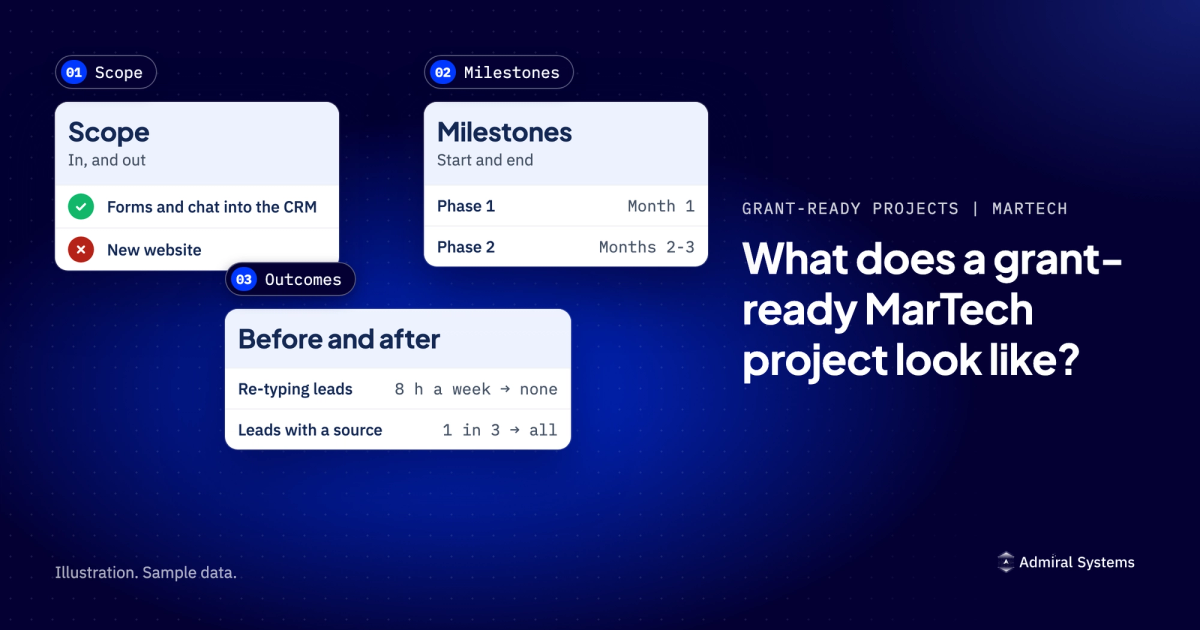
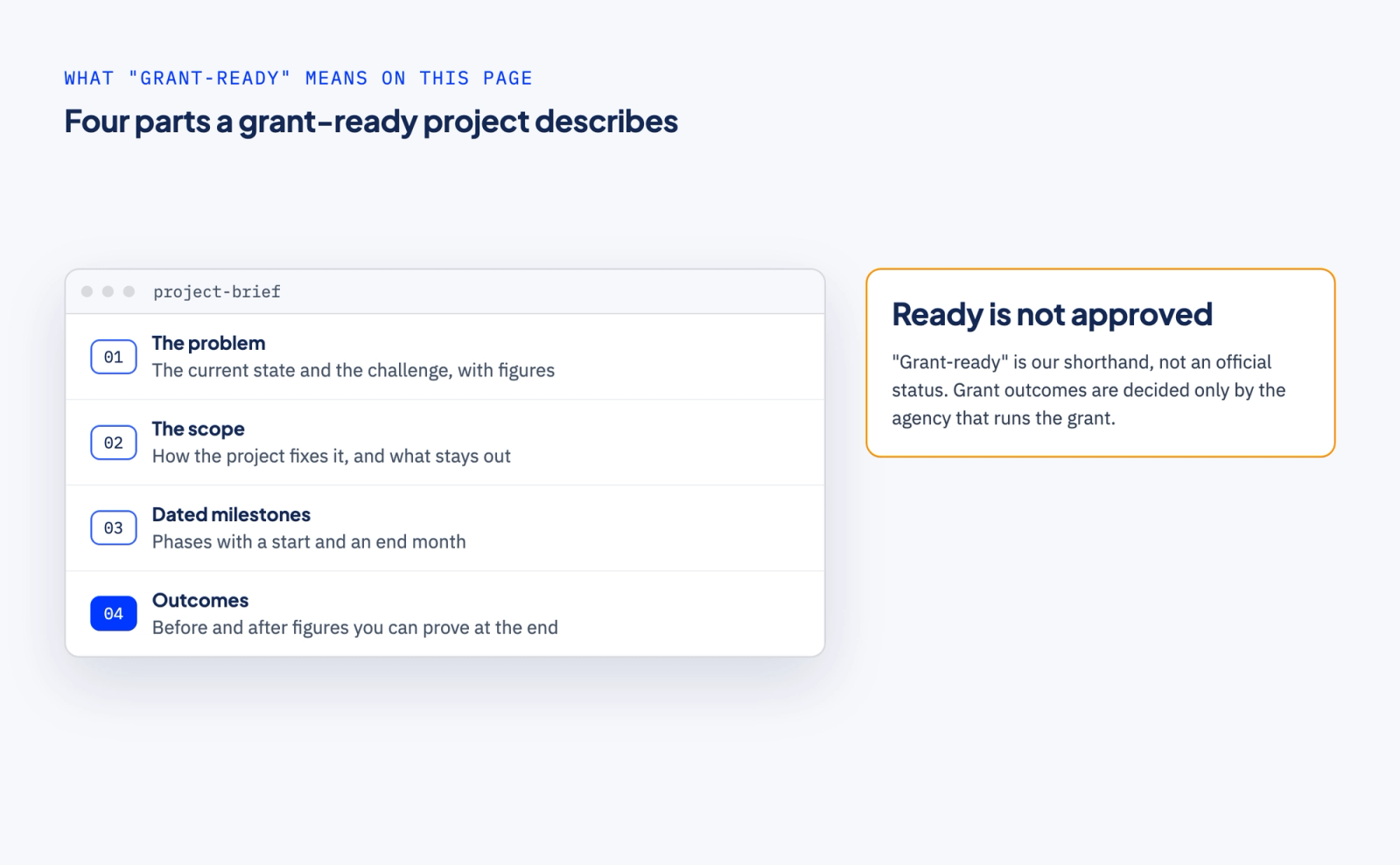
A grant-ready marketing technology project names the business problem, says how the project will fix it, lists dated milestones and states outcomes you can measure. One Singapore grant's past official templates asked for these. Ready does not mean approved.
A grant-ready marketing technology project names the business problem, says how the project will fix it, lists dated milestones and states outcomes you can measure. One Singapore grant's past official templates asked for these. Ready does not mean approved.
Last reviewed: 12 October 2026. Sources: Enterprise Singapore and the Business Grants Portal 2.0 FAQ (official).
"Grant-ready" is our shorthand, not an official status. On this page it means a project described the way one grant's past official templates asked: the problem, the scope, dated milestones and outcomes. It never means that a grant would approve the project.
The projects here are marketing technology (MarTech) projects. By MarTech we mean the software a company uses to find, win and keep customers, such as its website, its email tool and its customer relationship management (CRM) system.
The templates in the short answer are the Enterprise Development Grant (EDG) templates for capability projects and for productivity projects. The EDG template for market access projects used an expansion plan in place of the project section. Only the capability template had a separate outcomes section.
The key facts:
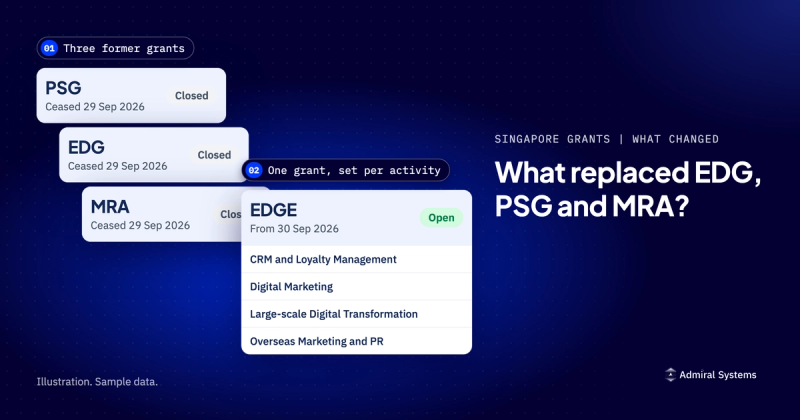
This page does not say which grant supports marketing work. For the current grant and its rules, read Enterprise Singapore's EDGE Grant page.
For how the portal works, read our pillar guide. For every section the templates asked for, read what goes into a grant project proposal.
The rest of this page shows three worked examples, then takes the three parts one at a time: scope, milestones and outcomes.
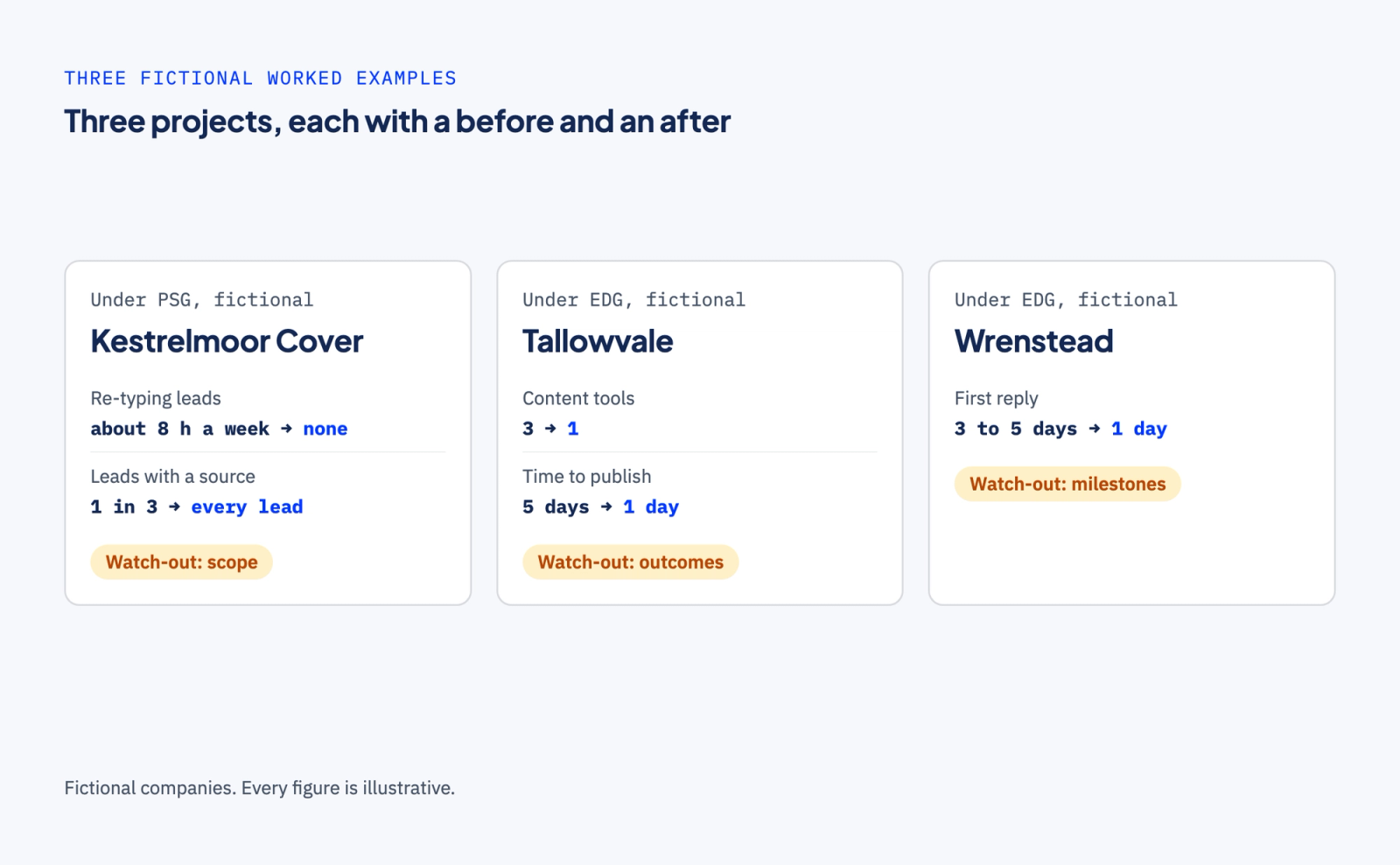
Kestrelmoor Cover is invented for this page. Every number in it is illustrative.
Milestones
The EDG templates asked for each phase's start and end in the form "Start (mm/yyyy)" and "End (mm/yyyy)".
Tallowvale is invented for this page. Every number in it is illustrative.
Milestones
Wrenstead is invented for this page. Every number in it is illustrative.
Milestones
The launch date falls after the last milestone, in Month 5 (illustrative).
The EDG market access template asked, "What is the target country and/ or market segment and reason(s)?", and Wrenstead's answer would be Malaysia and warehouse operators, because several of its existing customers already run sites there.
Our reading of the EDG templates is that they had no costs section. Under EDG, the portal form had its own step to "Provide Details of Costs", and quotations listed hardware and software costs "by number of units and unit cost" (EDG page). None of these examples shows a cost.
Want this for your own project? The Grant Project Planner turns a few short answers into a draft project brief in about three minutes. It is free, with no documents or login.
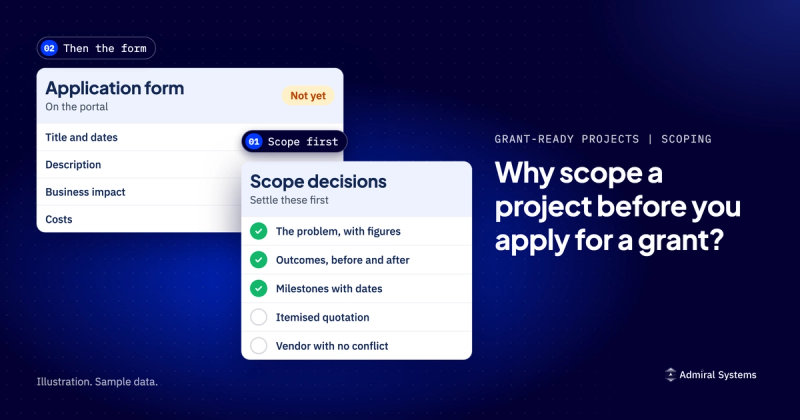
Our definition: a scope says what the project changes, what it delivers and what it leaves out.
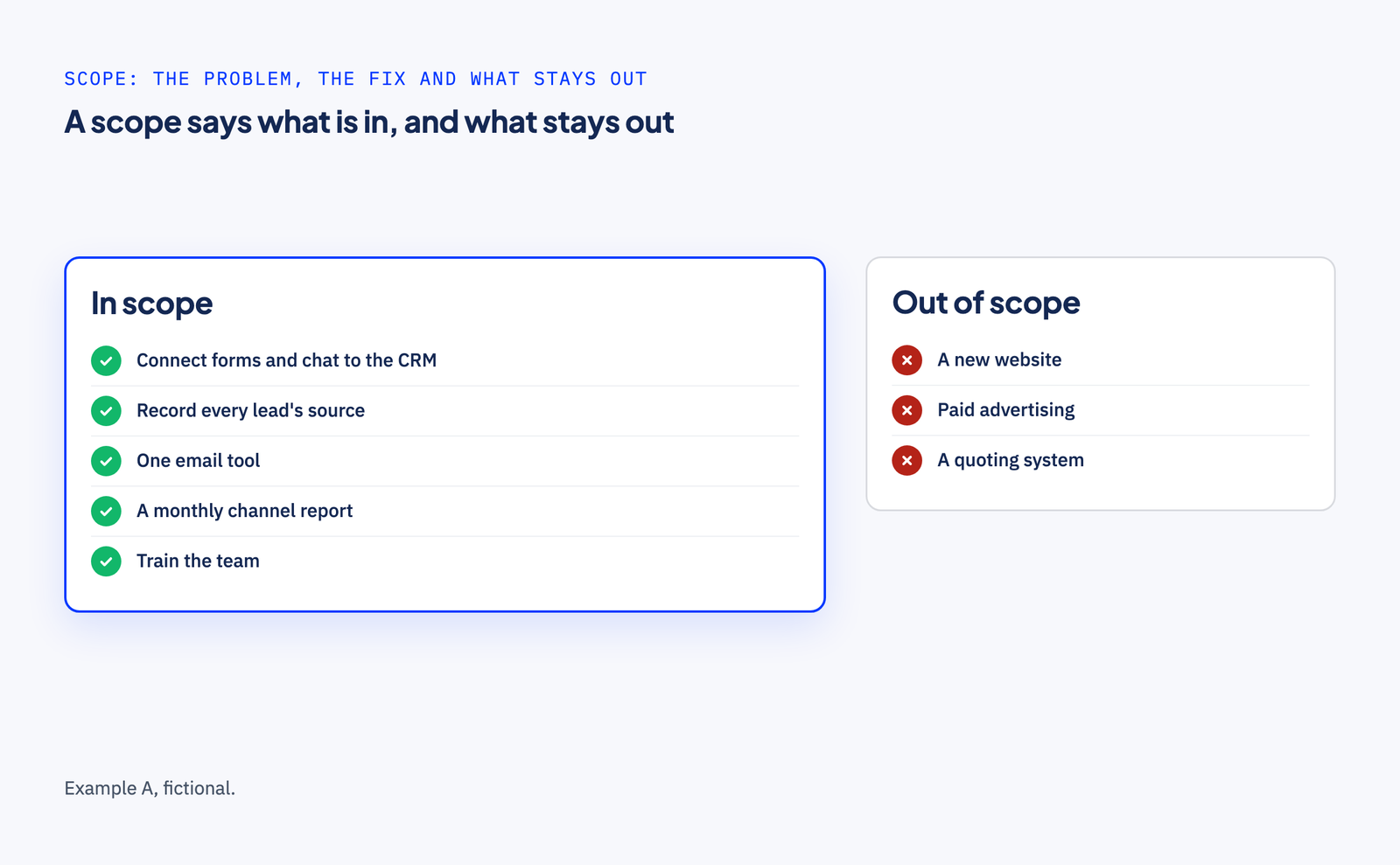
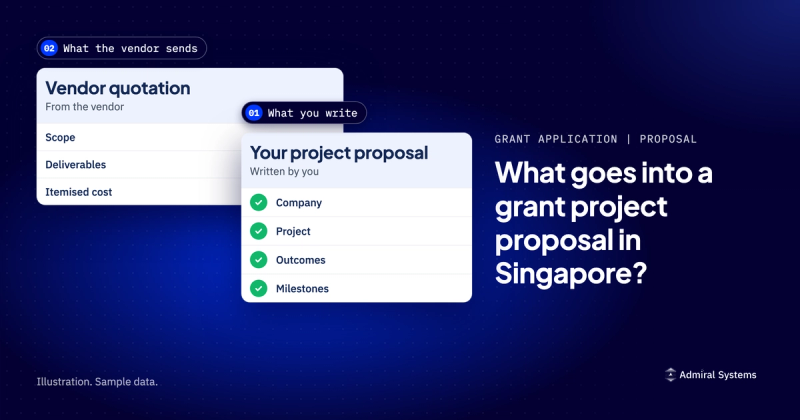
The EDG capability and productivity templates asked four questions about the project:
Scope was one of the three things EDG said it assessed. The EDG page said: "Applications will be assessed by EnterpriseSG based on project scope, project outcomes and competency of the service provider." It added: "Where applicable, EnterpriseSG may seek clarifications on the choice of vendor and/or alternative quotation source."
The official pages also set rules on the vendor:
One more rule matters when a project changes tools you already have. PSG, which has since closed, did not support an existing solution or a higher tier of one already in use. If a project mainly extends a tool you already use, check the current grant's own rule. Example A carries this watch-out.
Our own test comes before all of these. Would you still do this project if no grant existed? If the answer is no, the project is not ready.
The EDG templates asked for a milestone list with four fields, in this order:
Under EDG, the guide to the portal form (PDF) also asked: "Please indicate Project Title, Start Date, End Date and Project Description". For how the portal works as a whole, read our pillar guide.
Our suggestion: give each phase one output that someone can see, such as a working connection, a published page or a trained team.
EDG also gave advice on timing: "You are advised to keep the project timeline to a reasonable duration, to ensure the outcomes remain relevant in a rapidly changing economic environment." (EDG FAQ).
Each of the three closed schemes had a rule against starting early:
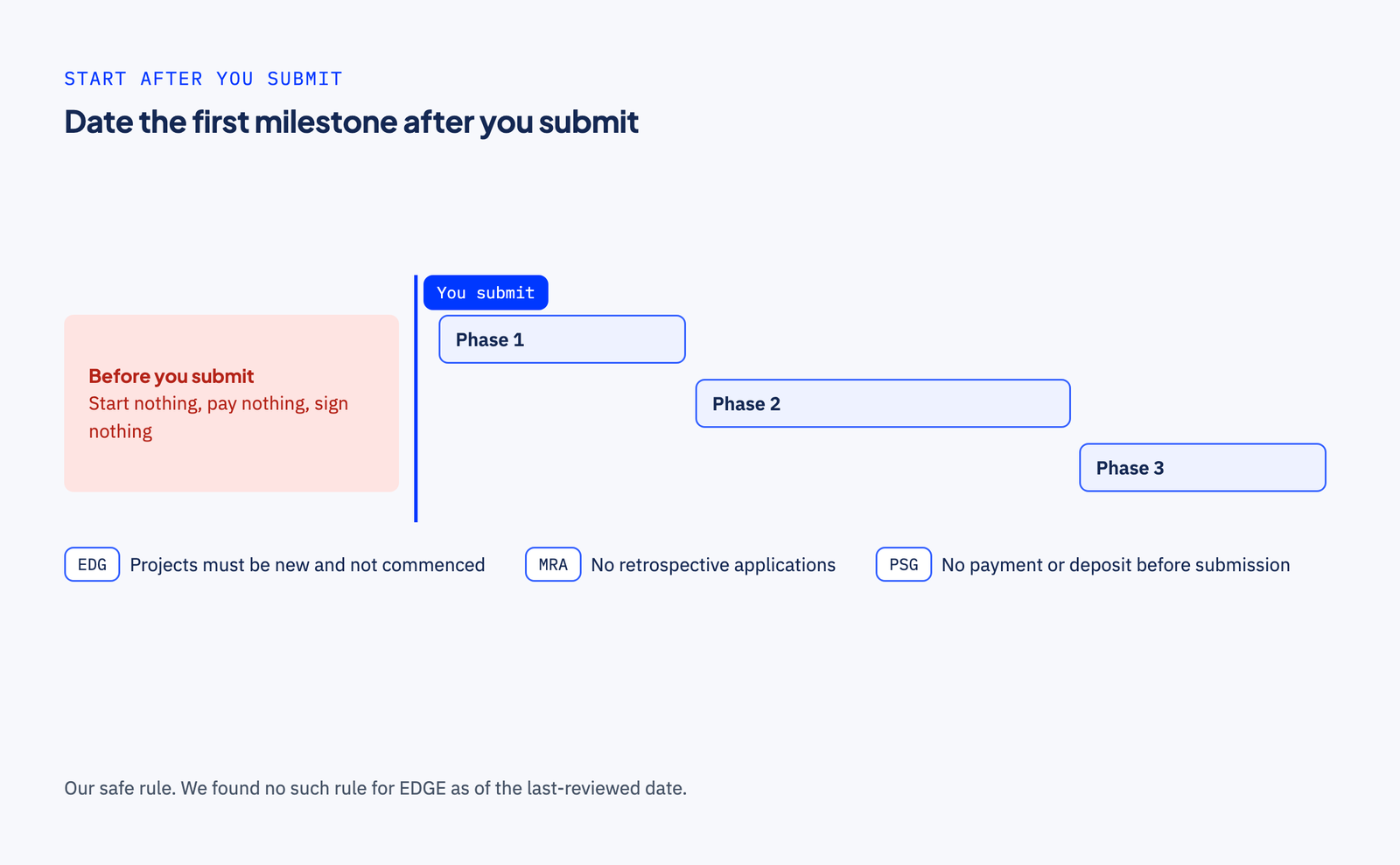
As of 12 October 2026, the EDGE activity pages we read list this condition: "Not have started work or made any payment or deposit to a supplier, vendor, or third party prior to application submission". Not every activity page sets the same rule, so read the page for the activity you plan. Our safe rule: start nothing, pay nothing and sign nothing before you submit. Example C shows why a fixed launch date makes this hard.
The EDG core capabilities template said: "List the quantitative outcomes and qualitative outcomes." The productivity template asked for "before and after productivity indicators" inside its project section. The productivity and market access templates had no separate outcomes section.
EDG also asked about people. The EDG page asked for "Impact on workers (Singaporean or PR) benefitting from project in the form of increased wages, job creation, job-redesign or training" (PR means permanent resident). This was an EDG question, and we do not treat it as a rule for any other scheme.
Our view: write only outcomes you can prove when the project ends. Example B shows the difference. Its outcomes count tools, days and welcome messages, not paid members.
If you run the company and sign for it, you may be weighing two objections. It sounds too expensive, and why not hire in-house instead?
Too expensive? It is a fair worry. Our view: a project stays affordable when its scope says what is in and what is out. Every example above has an out-of-scope line for that reason. The Grant Project Planner turns a few short answers into a draft project brief on screen, with no documents or login.
Why not hire in-house? Our view: in every example above, the company's own staff run the system at the end, so the skill stays in the company after the vendor leaves. Under EDG and MRA, third-party companies could not apply for or manage the grant for you. Under PSG, vendors could not apply for you.
A good project stands on its own. A grant does not decide whether the project is worth doing.
Plan it free first. Our Grant Project Planner asks a few short questions about your business and the bottleneck you want to fix, then gives you a draft project brief on screen in about three minutes. No documents, no login.
Want us alongside you? If the project spans several systems or vendors, or you would rather not run the project alone, tell us about it and check if we're a fit. We look up your company before we reply, and we reply within one working day, Singapore time. If you know something is wrong, but not yet what to fix, a Blueprint is a paid diagnosis that ends with a costed plan.
Admiral Systems is not associated with any Singapore government agency. This page reflects our understanding of official Enterprise Singapore and Business Grants Portal guidance as of 12 October 2026 and is not professional, legal or financial advice. Grant outcomes are decided solely by the agency that runs each grant. For the official answers, see the Business Grants Portal 2.0 FAQ.
Find the right engagement fit for your current need(s)
Go to Market
Consulting
Validate ideas with market research, strategic planning and prototyping. Ideal for exploring new concepts.
Martech
Implementation
Launch Low-code MVP or Custom Interactive websites with user-focused design. Perfect for quick market entry.
Growth & Marketing
Campaign Experimentation
Boost growth with scalable systems and marketing automation. Suited for advanced analytics and more.
For teams with a bigger appetite for growth
Martech
Transformation
Transform with system modernization and integration. Best for comprehensive digital change.
Martech
Growth Operations
Optimize performance and reduce technical debt. Ideal for efficiency and fine-tuning.

Enterprise Singapore sets the rules and can change them. In general, you need all three of these before your project is assessed.

The grant is run by Enterprise Singapore for companies registered and operating here.

You need to have sufficient funds available to pay for the entire project upfront.

You need a defined project with real deliverables, dates, and outcomes.














We can't wait to hear all about your game-changing ideas. Spill the tea!

Be the first to know on further updates on Growth contents for your organisation, don't miss out on our sneak peaks and exclusive community contents!