What goes into a grant project proposal in Singapore?
What goes into a grant project proposal in Singapore?
Grant
Haykal
12 Oct 2026
12
min read
Quick answer
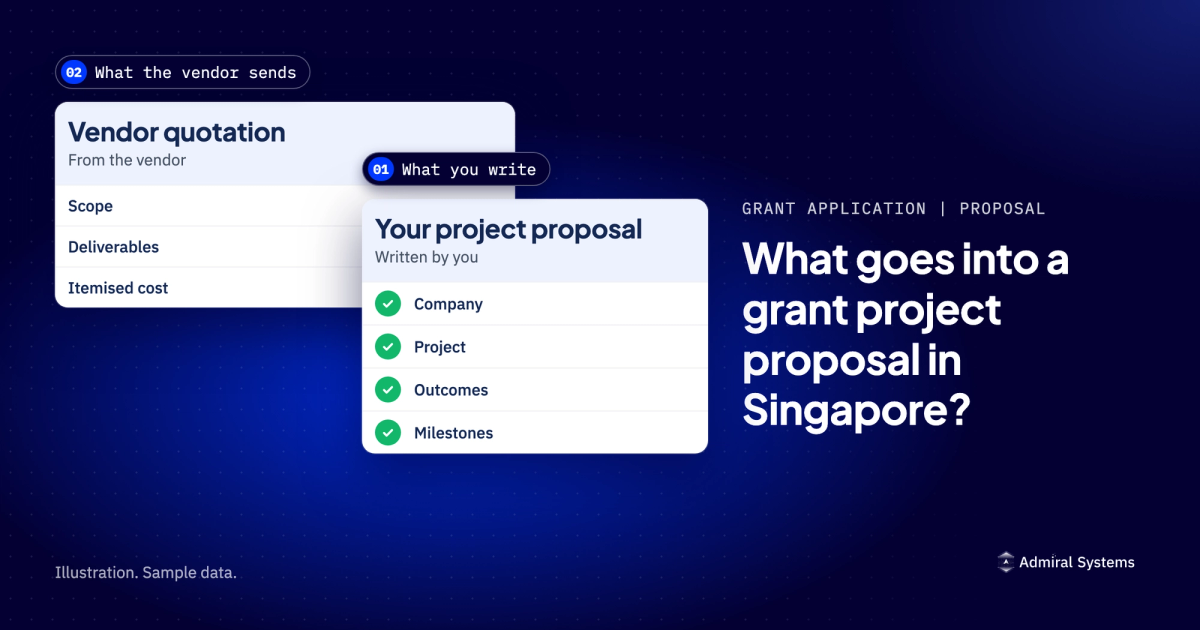
Past official templates for one Singapore grant asked for the company, the project (its problem, solution and chosen vendor), expected outcomes, and dated milestones. Costs went in the vendor's quotation and the portal form. Check what the current grant asks.
Key takeaways
Under the Enterprise Development Grant (EDG), the company's project proposal and the vendor's quotation were two different documents. Under the Market Readiness Assistance (MRA) grant, the application asked for a proposal or quotation from the consultant or vendor. The Productivity Solutions Grant (PSG) asked for a vendor quotation, and its portal form had its own step named Proposal.
The past official templates for the Enterprise Development Grant (EDG) asked about the company, the project, the outcomes and dated milestones.
Write outcomes as before and after figures you can prove at the end.
Do not pay, sign or start before you submit, and check the current grant's own rules.
The short answer
Past official templates for one Singapore grant asked for the company, the project (its problem, solution and chosen vendor), expected outcomes, and dated milestones. Costs went in the vendor's quotation and the portal form. Check what the current grant asks.
[@portabletext/react] Unknown block type "callout", specify a component for it in the `components.types` prop
The templates in that answer are the Enterprise Development Grant (EDG) project proposal templates for capability projects and for innovation and productivity projects. The EDG template for market access projects used an expansion plan in place of the project section.
Two documents called "proposal", and where each piece of information went
EDG, the Market Readiness Assistance (MRA) grant and the Productivity Solutions Grant (PSG) ceased on 29 September 2026 (as of October 2026), and Enterprise Singapore's EDGE Grant page said that from 30 September, companies should "apply for business grant support under the EDGE Grant".
As of the last-reviewed date, we found no EDGE proposal template on Enterprise Singapore's pages.
The official pages used the word "proposal" for two different documents. EDG asked for a "Project proposal" that the company wrote itself. MRA asked for a "Proposal and/or quotation from your consultant/vendor". EDG also asked for a consultancy proposal for a consultancy cost item.
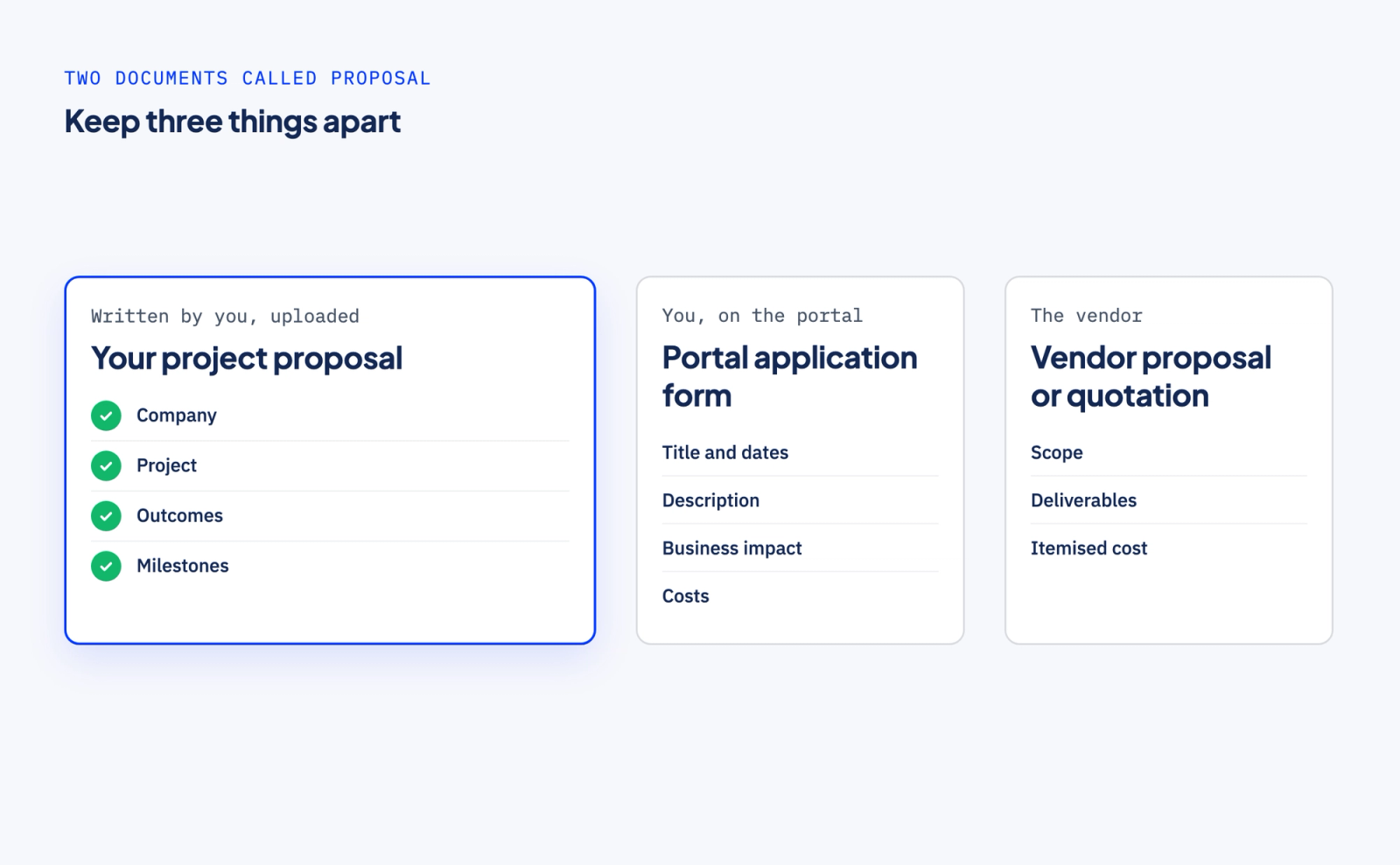
Keep three things apart.
Keep three things apart: your project proposal, the portal application form and the vendor's proposal or quotation.
Your project proposal
Who wrote it: your company.
What it held: the company, the project, the outcomes and the milestones.
Where it went: it was uploaded to the portal. The EDG guide to the portal form said: "Please upload project proposal and other supporting documents".
Which scheme: EDG. Under EDGE, the Large-scale Digital Transformation page lists "Project proposal, vendor proposals and quotations" among the documents to prepare. Not every activity page names a project proposal, so check the page for your activity. We found no company-written project proposal template for MRA, PSG or EDGE.
Source: Enterprise Singapore's three EDG project proposal templates, the EDG page and the EDG user guide for the portal.
The portal application form
Who wrote it: your company, directly on the portal.
What it held: under EDG, the form asked you to "Please indicate Project Title, Start Date, End Date and Project Description", then asked for business impact projections and cost details. EDG asked for projected figures such as "Company revenue", "Staff remuneration" and "Depreciation". Under PSG, the form asked you to "Fill up the reason for the solution and the intended start date of the project" and to "Fill in details of productivity gains".
Where it went: the form was the application itself. Under EDG, its steps included "Submit Your Proposal", "Explain The Business Impact" and "Provide Details of Costs". Under PSG, the steps included Proposal, Cost and Business Impact.
Which scheme: EDG and PSG.
Source: the EDG user guide for the portal, the EDG page and the PSG step-by-step guide.
The vendor's proposal or quotation
Who wrote it: the vendor or consultant.
What it held: under MRA, a "Detailed scope of services" and "Expected project deliverables". Under MRA and PSG, a "Cost breakdown by scope of services". The MRA checklist also asked for "Testimonials/credentials of the project team". PSG added a business impact block: "Description of overall impact" and "Details of productivity gains". For an EDG consultancy cost, it held "Consultancy proposal details with fee breakdown by phases, description of activity and man-days required".
Where it went: it was one of the documents submitted with the application. The EDG guide said: "For Consultancy cost item, you will need upload consultancy proposal and required certification".
Which scheme: MRA and PSG. Under EDG, the vendor's quotation, and the consultancy proposal for a consultancy cost.
Our reading of the three EDG templates, not an official statement: none of them had a section for costs, the project team, vendor details or key performance indicators (KPIs) by that name. Under EDG, costs sat in the vendor's quotation and the portal form, and business impact went into the portal form. Vendor details went into the vendor's proposal or quotation.
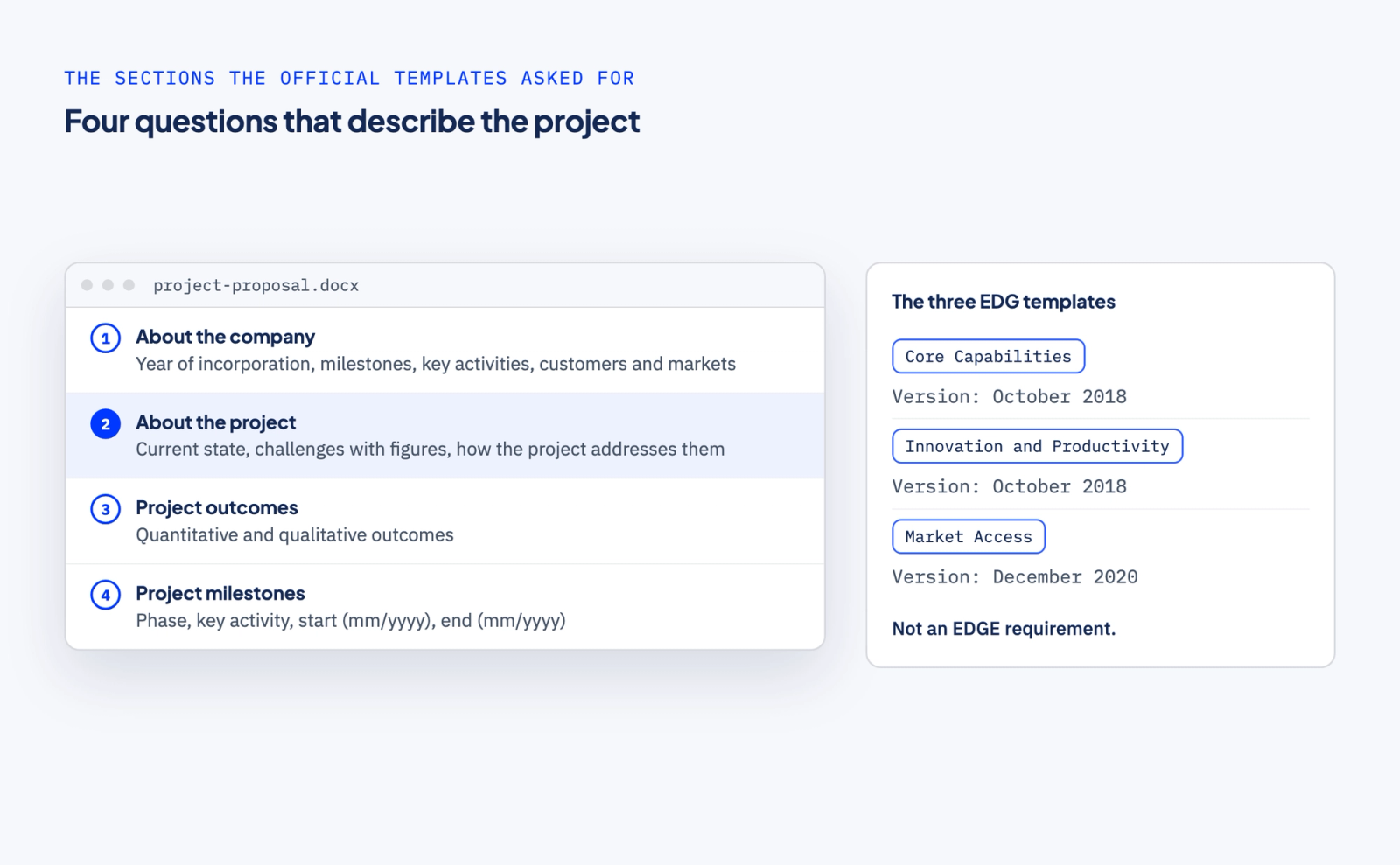
The sections below are what those templates asked for. They are not an EDGE requirement. In our view, the same four questions make sense for your project proposal under any grant, because each one describes the project.
The four sections the past EDG templates asked for. Not an EDGE requirement.
About the company
What the template asked: "Year of incorporation"; "How has the company progressed over the years? What are some significant milestones that the company has achieved?"; "Key business activities and products/ services"; "Key customer segments/ markets and overseas presence (if any)"; "Company’s growth plans and/ or targets for internationalisation".
Which template: Core Capabilities and Innovation and Productivity, in full. Market Access used a shorter version of this section.
Why it still matters (our view): the reader should see why this company, at this stage, needs this project.
About the project
What the template asked: "Describe the current state of your business operations or processes."; "Describe challenges or opportunities. Use figures where possible."; "How will the project address the above challenges/ opportunities?"; "Describe the reasons for your choice of consultant and/ or solution provider (if applicable)."
Which template: Core Capabilities. Innovation and Productivity asked the same questions for process redesign and automation projects.
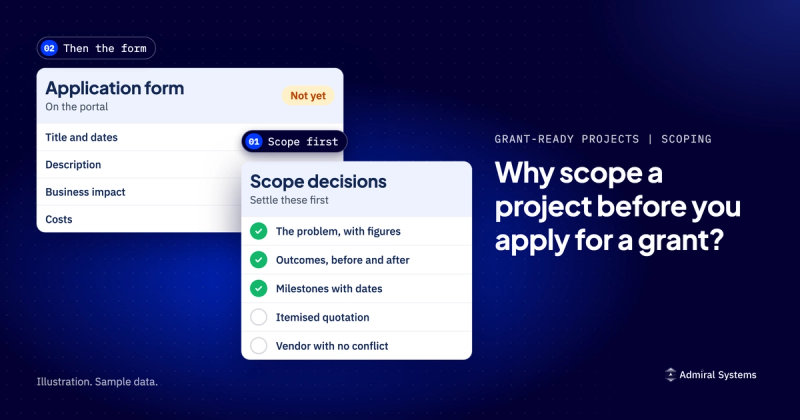
Why it still matters (our view): this is the scope. Scope was one of the three things EDG said it assessed.
Project outcomes
What the template asked: "How will this project help your company build new capabilities and contribute to your" growth or internationalisation plans, and "List the quantitative outcomes and qualitative outcomes." The Innovation and Productivity template asked instead: "What productivity improvements do you expect to derive from the project? (please illustrate with before and after productivity indicators)".
Which template: only Core Capabilities had a separate outcomes section. Innovation and Productivity and Market Access had no separate outcomes section. Innovation and Productivity asked for productivity indicators inside the project section.
Why it still matters (our view): write each outcome as a before figure and an after figure.
Project milestones
What the template asked: a list of phases with the columns "Phase", "Key Activity", "Start (mm/yyyy)" and "End (mm/yyyy)". The example row was "Eg. Business requirements gathering".
Which template: all three.
Why it still matters (our view): dated milestones turn an idea into a plan someone can check.
Outcomes became the test at the end
MRA: MRA listed "Proof of completion, including KPIs stated in business proposal or quotation". It also said: "Achievement of project deliverables is assessed to determine if the project has been completed satisfactorily."
EDG: "Claims can be submitted when all project deliverables have been achieved." The end-of-project report had a clear job: "The report should demonstrate how the outcomes or deliverables have been met."
Our view: write only outcomes you can prove later.
EDGE project conditions
These are not template sections. Under EDGE, some of the activity pages we read list "Project conditions". For example, the Large-scale Digital Transformation page includes "The project must demonstrate measurable impact on company growth and efficiency" and "Involve integration and/or standardisation efforts across systems such as business, sales, and procurement". The page lists another condition as well, and the lists differ by activity. Check the page for your activity.
What the official pages said they assessed
These are the assessment statements we found on the official pages, each tagged with its scheme. For the EDGE Grant, as of October 2026, the EDGE Grant FAQ says under its "Internationalisation" heading: "Each application will be assessed based on the project scope, deliverables, and alignment with the company's overseas expansion objectives." Other answers in that FAQ mention assessment too. Check the page for your activity.
Scope, outcomes and the provider (EDG, EDG page): "Applications will be assessed by EnterpriseSG based on project scope, project outcomes and competency of the service provider."
Your project proposal as a key document (EDG, all three project proposal templates): "As the proposal is a key document for the evaluation, please ensure information provided is relevant and complete."
Business plans and project outcomes (EDG, EDG FAQ): "Companies would need to submit individual project proposals with details on their business plans and project outcomes for evaluation."
Financial readiness (EDG, EDG page): "Company is financially ready to start and complete the project. Commonly used financial indicators, such as the current ratio, will be used for assessment."
Company financial information (general, Business Grants Portal FAQ on GoBusiness and its general FAQ): the Accounting and Corporate Regulatory Authority (ACRA) provided agencies the company's details and financial information. Of to-date unaudited financial statements, the FAQ said: "The agency processing your application will assess these."
Impact on workers (EDG, EDG FAQ and EDG page): "Worker outcomes include increase in wage increment, job creation, job re-design, or training for existing staff." The EDG page asked for "Impact on workers (Singaporean or PR) benefitting from project in the form of increased wages, job creation, job-redesign or training" (PR means permanent resident).
The choice of vendor (EDG, EDG page): "Where applicable, EnterpriseSG may seek clarifications on the choice of vendor and/or alternative quotation source."
Business use and reasonableness (PSG, PSG FAQ): "Please note that the supportability is subject to further assessment on business use and reasonableness."
Fit with the grant's intent (EDG, EDG FAQ): "Projects that are not aligned with the intent of the Enterprise Development Grant (EDG), or those that have already commenced, will not be supported."
A reasonable timeline (EDG, EDG FAQ): "You are advised to keep the project timeline to a reasonable duration, to ensure the outcomes remain relevant in a rapidly changing economic environment."
Want the decisions before the writing? The Grant Project Planner turns a few short answers into a draft project brief in about three minutes. It is free, with no documents or login.
A fictional worked example
[@portabletext/react] Unknown block type "callout", specify a component for it in the `components.types` prop
Larkspur Movement Studios is invented for this page. Every number in it is illustrative.
About the company
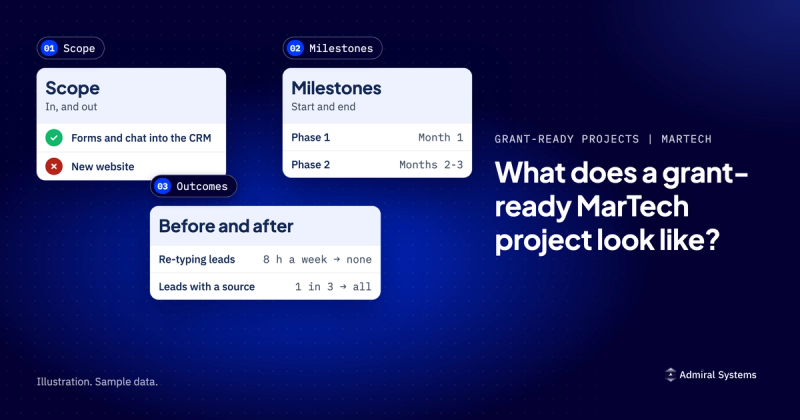
Larkspur Movement Studios runs a group of three Pilates and movement studios in Singapore, with about 25 staff (both illustrative). Members book classes online. The company plans to open a fourth studio (illustrative) and wants its member records in order before it does.
About the project
Current state: the studios' booking system and their customer relationship management system (CRM), the database that holds each member's contact details and history, are not connected. Front-desk staff export a spreadsheet each week to move the data across, which takes about 6 hours of work a week (illustrative).
Challenge, with figures: members who stop booking for 30 days (illustrative) get no follow-up, because nobody sees the gap in time.
How the project addresses it: connect the booking system to the CRM, set up automatic messages for new and lapsing members, build one weekly report, and train staff to run it.
Choice of vendor: a marketing technology vendor, chosen for its experience with the studios' booking system and for an itemised quotation.
Project outcomes
Quantitative, before and after: manual export time falls from about 6 hours a week to under 1 hour a week (illustrative). Lapsing members contacted within 7 days (illustrative) rise from none to all.
Qualitative: one view of each member's booking history, and front-desk staff trained to run the member messages themselves.
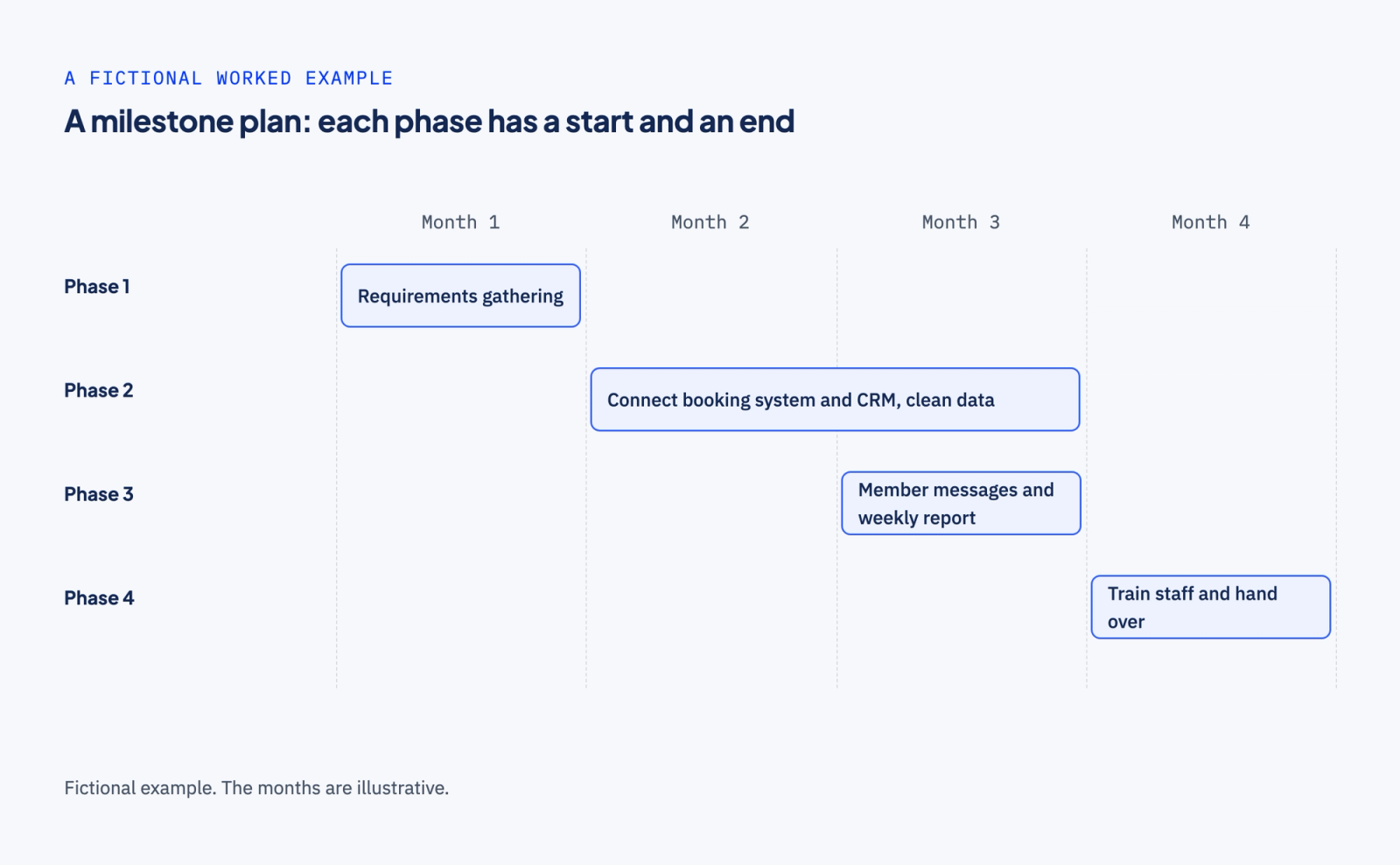
Phase 2. Key activity: connect the booking system and the CRM, and clean the member data. Start: Month 2. End: Month 3.
Phase 3. Key activity: build and test the member messages and the weekly report. Start: Month 3. End: Month 3.
Phase 4. Key activity: train staff and hand over. Start: Month 4. End: Month 4.
A fictional milestone plan. The months are illustrative.
Where the cost goes
Under EDG, the cost sat in the vendor's itemised quotation and in the portal form, not in the project proposal. This example shows no cost.
Notice that every heading describes the project, not the grant.
Mistakes the official pages warned about
Each mistake below comes from a rule or rejection reason on an official page, tagged with its scheme. The suggestions are ours.
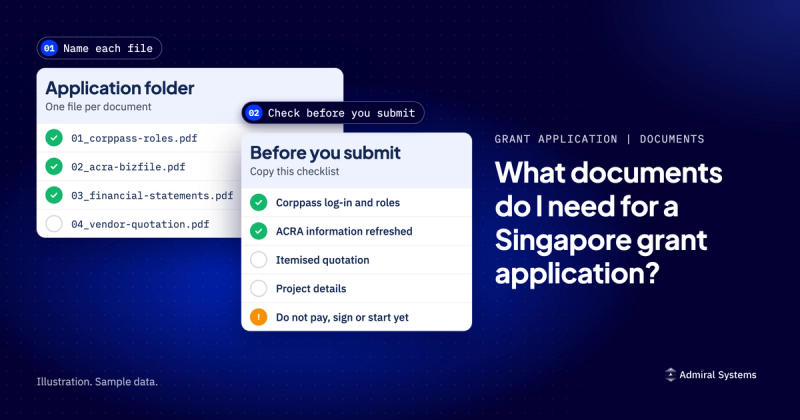
Starting, paying or signing before you submit
What the official pages said: EDG: "Note that projects must be new, have not commenced, and are not generating any revenue at the point of grant application." EDG counted "Applicant started work", "Applicant made payment to third-party, who is part of the application" and "Applicant signed contractual agreement with a third party, who is part of the application" as a started project. MRA: "Companies can only sign contracts with third-party consultants or vendors after submitting their application." PSG: "Retrospective applications (i.e., grant applicant must not have made payment, and/or any form of deposits prior to application submission) will not be supported." PSG did allow a start after submission, at the company's own risk: "However, you will not be able to claim subsequently if the application is unsuccessful." EDGE: the Large-scale Digital Transformation page says work, payments and deposits must not happen before submission. It lists: "Not have started work or made any payment or deposit to a supplier, vendor, or third party prior to application submission". Not every activity page sets the same rule. The Overseas Physical Trade Fairs page does not list it, and says "Payments or deposits made to secure booth space prior to application submission are permitted".
What to do instead (our suggestion): our safe rule is to start nothing, pay nothing and sign nothing before you submit. Check the page for your activity before you pay anything.
A vendor with a link to your company
What the official pages said: EDG expected that "suppliers and service providers engaged in this project do not have any relationship, connection, association or dealings with the Applicant". MRA said an application would be rejected if a conflict of interest was found between the applicant and its third-party consultant or vendor.
What to do instead (our suggestion): choose a vendor with no ownership, family or business tie to your company.
Letting a vendor or consultant apply for you
What the official pages said: EDGE: the activity pages we read say "Third-party companies are not permitted to apply for or manage the grant on behalf of the applicant company." EDG and MRA: "Third party companies are not allowed to apply or manage the grant on behalf of applicant companies." PSG: "Vendors are strictly not allowed to apply on behalf of applicants."
A quotation that is not itemised, or not in your registered company name
What the official pages said: MRA: "The quotation should provide an itemised cost breakdown." MRA and PSG: "Quotations must be addressed to the registered company name as per company’s ACRA Bizfile." and "Short-forms and/or other names will not be accepted". EDG asked for "Quotation of hardware and software costs by number of units and unit cost". We found no EDG rule on the company name on quotations.
What to do instead (our suggestion): ask for an itemised quotation in your registered company name before you apply.
Asking for a tool you already use
What the official pages said: PSG: "Companies will also not be supported for their PSG application if this is an existing solution/a higher tier of the solution which they are already using."
What to do instead (our suggestion): make clear what is new in the project.
Changing vendor after approval
What the official pages said: PSG: "No changes to vendor/solution package are allowed after application is approved."
What to do instead (our suggestion): settle the vendor before you apply, and choose with care.
Your project proposal is a project plan first
If you run a small company, you may wonder whether to pay someone to write your project proposal or to do it in-house. Our view: the writing is yours to do, and it costs you time, not a fee.
The official rules pointed the same way. Under EDG and MRA, third-party companies could not apply for or manage the grant on behalf of the company. Under PSG, vendors could not apply for it. Under MRA, outside help was for work the company could not do itself: "MRA supports eligible third-party costs for activities and services that companies do not have the in-house or internal capabilities to carry out."
The hard part is not the writing. EDG said it assessed "project scope, project outcomes and competency of the service provider". Each of those is a project decision: what you will change, how you will know it worked, and who will do the work. None of that is paperwork.
So start with the plan, not the prose. Once you know what will change, how you will know it worked and who will do the work, your project proposal becomes a record of decisions you have already made, and it agrees with the vendor's quotation.
Plan it free first. Our Grant Project Planner asks a few short questions about your business and the bottleneck you want to fix, then gives you a draft project brief on screen in about three minutes. No documents, no login.
Want us alongside you? If the project spans several systems or vendors, or you would rather not run the project alone, tell us about it and check if we're a fit. We look up your company before we reply, and we reply within one working day, Singapore time. If you know something is wrong, but not yet what to fix, a Blueprint is a paid diagnosis that ends with a costed plan.
Grant outcomes are decided only by the agency that runs the grant.
Admiral Systems is not associated with any government agency. This page is our understanding of the official guidance, not professional advice. For the official answer, read the Business Grants Portal 2.0 FAQ.
Frequently asked questions
Not as of the last-reviewed date on this page. We found no EDGE proposal template on Enterprise Singapore's pages. Some of the EDGE activity pages we read, such as the Large-scale Digital Transformation page, list "Project conditions" and name a "Project proposal" among the documents to prepare. The pages differ, so check the page for your activity on the Enterprise Singapore website.
No. Under the Enterprise Development Grant (EDG), the company's project proposal and the vendor's quotation were two different documents. Under the Market Readiness Assistance (MRA) grant, the application asked for a proposal or quotation from the consultant or vendor. The Productivity Solutions Grant (PSG) asked for a vendor quotation, and its portal form had its own step named Proposal. All three schemes have since ceased.
No. The EDGE activity pages we read say: "Third-party companies are not permitted to apply for or manage the grant on behalf of the applicant company." Under the Enterprise Development Grant (EDG) and the Market Readiness Assistance (MRA) grant, third-party companies could not apply for or manage the grant for you. Under the Productivity Solutions Grant (PSG), vendors could not apply for you.
Not for applications on the Business Grants Portal. As of October 2026, the Business Grants Portal FAQ on GoBusiness said: "If your application is rejected, you will not be able to appeal but you can check with the processing agency on the reason for rejection." That answer does not name EDGE. Under the Enterprise Development Grant (EDG), Enterprise Singapore also advised: "You may wish to consider why the previous application was rejected before submitting a new application."
Important Notice: Admiral Systems is the new brand identity of Devhaus Pte. Ltd. (UEN: 202008696G). While we were previously known as Devhaus, please note that we are no longer affiliated with the domain devhaus.com.sg. For authentic Admiral Systems services, you're in the right place.